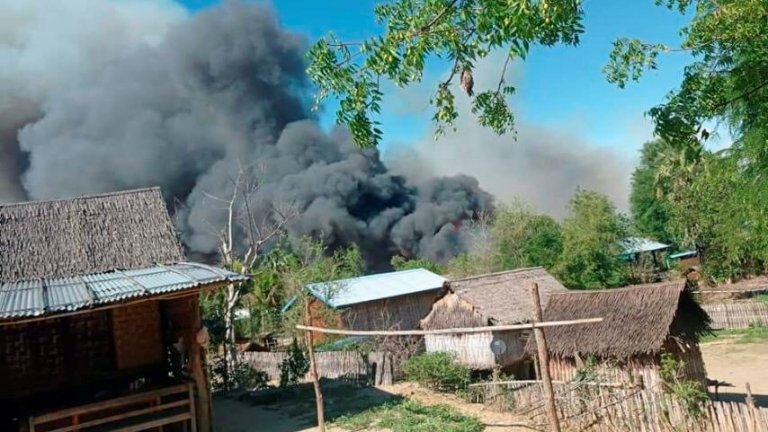
KANGPOKPI: The arson attack on Kharam Vaiphei village in Kangpokpi district on May 30 has drawn strong condemnation from several Kuki-Zo civil society organisations, which have demanded a thorough investigation, accountability for those responsible, and enhanced protection for vulnerable villages in the region.
The Kuki Organisation for Human Rights Trust (KOHUR) described the incident as a serious failure of civilian protection mechanisms in the violence-affected Leimakhong belt. The organisation alleged that armed cadres of the NSCN-IM and ZUF-K were responsible for the attack on the Kuki-Zo village under Kangchup Police Station jurisdiction, calling it a grave violation of human rights and an assault on the lives, homes and dignity of innocent civilians.
KOHUR noted that the attack occurred shortly after the redeployment of a company of the Central Reserve Police Force (CRPF) to the area under official orders aimed at maintaining law and order. Questioning the effectiveness of the security arrangement, the organisation said the incident raised serious concerns about the ability of security forces to prevent such attacks despite their presence in the vicinity.
The human rights body further expressed concern over what it termed the prolonged neglect of Kuki-Zo villages in the Leimakhong region. It alleged that more than five Kuki-Zo villages had been attacked and set ablaze by armed Naga groups over the past two years, while no arrests had been made in connection with those incidents.
According to KOHUR, the absence of accountability has fostered a climate of impunity, emboldening armed groups and leaving civilians vulnerable. The organisation argued that repeated attacks, coupled with the lack of justice for victims, reflected a troubling pattern of insecurity in the region.
KOHUR demanded an independent investigation into the Kharam Vaiphei attack, prosecution of those responsible, accountability for any security lapses, rehabilitation and compensation for affected families, and permanent security arrangements for vulnerable Kuki-Zo settlements. It also appealed to the Government of India, the National Human Rights Commission and international human rights bodies to take note of the situation and ensure justice for the victims.
Meanwhile, the Committee on Tribal Unity (CoTU) also strongly condemned the attack, alleging that cadres of the proscribed NSCN-IM and its alleged proxy outfit, the ZUF (Kamson faction), were behind the arson.
Describing the incident as a calculated act intended to provoke the Kuki-Zo community, CoTU said the attack came at a particularly sensitive time when tensions remained high following the killing of three Kuki-Zo church leaders on May 13 and the continued captivity of 14 Kuki-Zo villagers reportedly held in Senapati district.
The organisation alleged that the attack was aimed at aggravating an already fragile situation in the hill districts and criticised security forces deployed in and around Kharam Vaiphei for allegedly failing to prevent armed militants from operating in the fringe areas of Kangpokpi and Tamenglong districts.
CoTU further claimed that certain armed groups were attempting to create hostility between Kuki-Zo and Naga communities through intimidation, arson and threats of eviction. The organisation also alleged that political interests were exploiting the prevailing situation to trigger renewed communal unrest.
Calling for immediate government intervention, CoTU urged the state administration led by Chief Minister Y. Khemchand Singh to restore public confidence by enforcing law and order and taking decisive action against those responsible for the violence. It maintained that lasting peace could only be achieved through impartial governance and equal treatment of all communities.
The Kuki Students’ Organisation Sadar Hills (KSO-SH) also condemned what it described as a “calculated assault” on Kharam Vaiphei village in Kangchup Geljang Sub-Division, alleging that the attack was a deliberate and premeditated operation carried out by the NSCN-IM and the Kamson faction.
The student body characterised the incident as an attempt to terrorise the Kuki-Zo population and accused the attackers of targeting the village through a coordinated campaign of violence. It alleged that repeated security operations had forced local village volunteers to vacate the area, leaving settlements vulnerable to attacks.
KSO-SH further linked the incident to what it described as a broader pattern of aggression against the Kuki-Zo community, noting that it occurred barely a month after the killing of three church leaders in an ambush between Kotjim and Kotlen.
The organisation also questioned the conduct of a CRPF unit stationed in the area, alleging that despite being present, personnel failed to take adequate action to protect the village during the attack. It demanded an impartial inquiry into the role of the deployed security personnel and called for accountability where necessary.
Holding the NSCN-IM and the Kamson faction responsible for the incident, KSO-SH demanded the immediate arrest of all those involved. The student body also warned of intensified democratic agitation if decisive action was not taken, while reaffirming its commitment to safeguarding Kuki-Zo villages and communities.
In addition, KSO-SH appealed to media organisations to exercise caution and ensure proper verification before publishing reports related to the incident.
The attack has intensified concerns over security in the Leimakhong-Kangchup region, with Kuki-Zo organisations collectively urging authorities to ensure justice for the victims, strengthen security measures, and prevent further violence in vulnerable areas.