KANGPOKPI: The Kuki Organisation for Human Rights Trust (KOHUR) has strongly rebutted a recent statement issued by the United Naga Council (UNC), accusing the apex Naga body of attempting to shield those responsible for the killing of three prominent Kuki-Zo church leaders and calling for a court-monitored investigation by the National Investigation Agency into the incident.
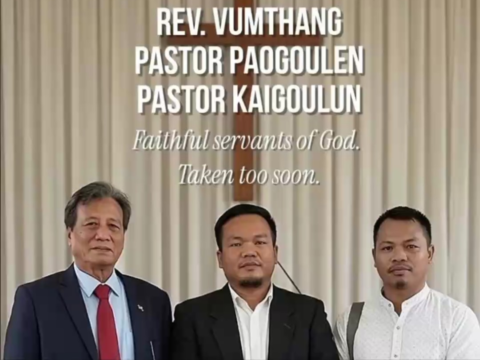
In a rejoinder issued in response to the UNC’s May 29 statement, KOHUR alleged that the May 13 ambush in which Rev. Dr. Vumthang Sitlhou, Rev. Kaigoulun Lhouvum and Pastor Paogoulun Sitlhou lost their lives was not an isolated act of violence but part of a broader and coordinated effort aimed at escalating ethnic tensions in Manipur.
The rights organisation accused the UNC of attempting to influence public perception by declaring the innocence of certain organisations before the completion of official investigations. According to KOHUR, the determination of responsibility should be left to competent investigating agencies rather than public pronouncements.
KOHUR maintained that the slain church leaders were specifically targeted because of their influential roles in promoting Kuki-Zo unity and advancing inter-community reconciliation efforts. It particularly highlighted their involvement in the formation of the United Baptist Council (UBC), which it described as an emerging religious platform that operated independently of structures traditionally associated with Naga leadership.
Rejecting the UNC’s contention that Naga armed groups had no motive to attack the pastors, KOHUR argued that the growth of the UBC had altered existing religious and institutional dynamics in the region and therefore could not be dismissed as irrelevant to the investigation.
The organisation further alleged that the attack bore the characteristics of a carefully planned operation. It claimed that information reportedly available with investigating authorities suggested that the ambush on the church leaders and the near-simultaneous interception and abduction of Kuki-Zo civilians in the Ireng area occurred within a span of approximately 15 to 20 minutes, indicating a level of coordination that warranted deeper scrutiny.
KOHUR also dismissed claims that the attackers spoke in a Kuki dialect, describing such assertions as misleading. It maintained that survivors and victims had identified the assailants as Naga gunmen from Manipur.
Citing previous incidents, including attacks on K. Songlung village and the recent arson at Kharam Vaiphei in Kangpokpi district, the organisation alleged that armed Naga groups had repeatedly conducted operations in Kuki-Zo inhabited areas despite the presence of security forces.
The rights body also referred to a Bolero Camper vehicle that allegedly passed through the ambush site shortly before the attack. According to KOHUR, the vehicle, bearing a Rongmei Naga name on its windscreen, was allowed to proceed unhindered, while vehicles carrying the church leaders were subsequently targeted.
Questioning the credibility of denials issued by various factions of the Zeliangrong United Front (ZUF), KOHUR pointed to what it described as inconsistencies between statements issued by the recognised Zeliangrong United Front and groups identifying themselves as “ZUF-K.”
The organisation also criticised what it interpreted as an attempt to rationalise the killing of Rev. Dr. Sitlhou by linking his reconciliation efforts to political sensitivities. Describing the late church leader as a dedicated advocate of Kuki-Zo-Naga harmony, KOHUR stated that any effort to justify or minimise the significance of his killing was deeply inappropriate.
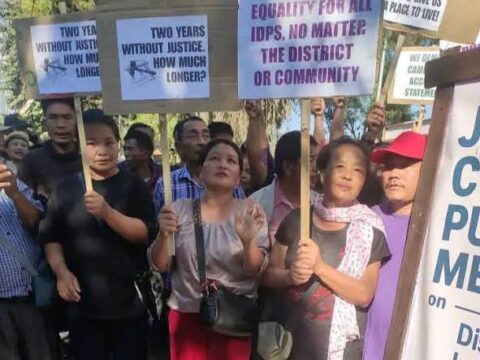
KOHUR further renewed concerns over the continued captivity of 14 Kuki-Zo men allegedly being held in Senapati district and called for their immediate, safe and unconditional release. While reiterating its opposition to hostage-taking under any circumstances, the organisation accused the UNC of failing to adequately address the plight of those still in captivity.
KOHUR challenged the credibility of the Thadou Inpi Manipur (TIM), whose statements had been referenced by the UNC. The rights body alleged that TIM lacked legitimacy and had been publicly disowned by recognised Thadou institutions, including the Thadou Inpi General Headquarters and Thadou Inpi-Sadar Hills. It further claimed that TIM had been created to foster divisions within the broader Kuki-Zo community, allegations that TIM has previously denied.
KOHUR further asserted that the killings of the three church leaders, the injuries sustained by five others, the abduction of civilians, and the recent attacks on Kuki-Zo villages constituted a serious violation of fundamental human rights.
The organisation renewed its demand for a court-monitored NIA investigation covering the killings, related abductions, and recent attacks on Kuki-Zo villages, including Kharam Vaiphei. It also stated that it would continue documenting developments and presenting its findings before constitutional authorities in India as well as international human rights bodies.
KOHUR expressed confidence that an independent and impartial investigation would ultimately establish the facts surrounding the killings and ensure accountability for those found responsible.