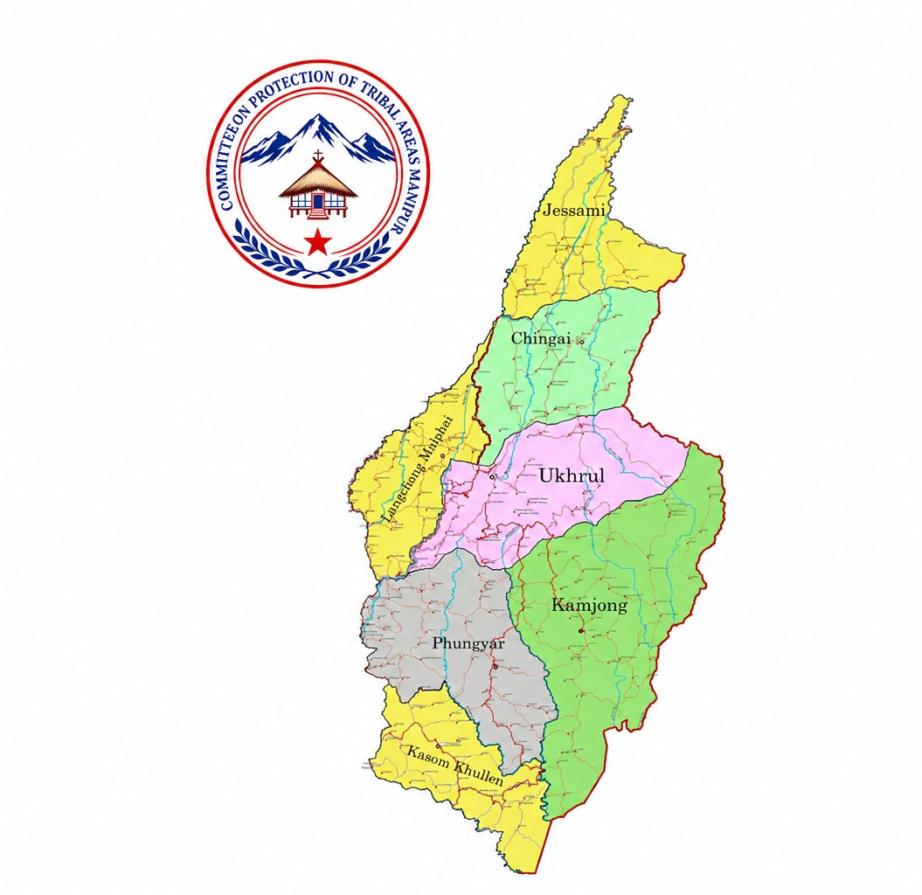
CHURACHANDPUR: The Committee on Protection of Tribal Areas Manipur–Kuki Hills (COPTAM-KH) has strongly condemned what it described as “historically fabricated claims” made by the Tangkhul Naga Long (TNL) regarding Ukhrul and Kamjong districts, asserting that the two districts have long been multi-tribal regions with documented Kuki ancestral presence and political authority.
In a detailed press statement issued today by its Secretary, Media and Publicity Wing, COPTAM-KH accused TNL of attempting to portray present-day Ukhrul and Kamjong as “exclusive territories of a single community,” calling such assertions a distortion of history and an attempt to erase the historical existence of the Kuki people from their ancestral domains.
The organisation stated that no political body or organisation could “rewrite recorded history or monopolize territories historically inhabited and administered by multiple indigenous tribal communities.” It argued that historical records overwhelmingly establish the long-standing territorial jurisdiction, hereditary chieftainship, and political authority of Kukis across substantial parts of present-day Ukhrul and Kamjong districts.
COPTAM-KH cited several colonial-era documents to support its claims, particularly referencing the British military record Secret–Confidential: Plan of Operations Against the Kuki Rebels (1918). According to the organisation, the document identified the Chassad Kuki polity within the Assam operational sphere, with Chassad functioning as a political capital under Chief Pache (Pase).
The statement asserted that the colonial record officially recognized:
A centralized Kuki political settlement;
A hereditary Kuki chief exercising territorial authority; and
A distinct Kuki political and territorial unit.
The organisation further claimed that the document clearly demarcated territorial boundaries covering large portions of modern-day Ukhrul and Kamjong districts. It listed the territorial extent as stretching eastward from the Chindwin River to Homalin and Kongal Thana, southward through Chandrakhong via Sarpung, and westward along the Thoubal River.
“These official records completely destroy the false narrative that Ukhrul and Kamjong historically belonged exclusively to one community,” the statement said, adding that the evidence demonstrated that Kuki territories possessed organized governance systems and recognized frontiers long before the emergence of present-day district boundaries.
COPTAM-KH also referred to The Gazetteer of Manipur (1886), authored by Captain E.W. Dun, stating that the Chassads were earlier identified as “Haukibs” around 1836, which the organisation said further established the continuity of Kuki chief-based political identity and territorial authority in the region.
The organisation additionally drew attention to post-independence administrative records, particularly the Manipur Gazette dated January 25, 1950, which declared Manipur a single district divided into several sub-divisions, including Sadar, Ukhrul, and Mao.
According to the statement, present-day Kangpokpi district emerged from the erstwhile Sadar Sub-Division, while Senapati district originated from the former Mao Sub-Division.
Based on these records, COPTAM-KH argued that attempts to politically subordinate Kangpokpi or Kuki ancestral territories under later “ethnic exclusivist narratives” lacked administrative and historical basis.
The organisation also rejected what it termed TNL’s “dangerous attempt” to claim unilateral authority over multi-tribal territories. It asserted that constitutional provisions under Article 371C, the Hill Areas Committee Order of 1972, and customary tribal land systems do not recognize any one ethnic organisation as the sole owner of historically shared indigenous territories.
“Ukhrul and Kamjong have always been multi-tribal regions inhabited by different indigenous communities, including the Kukis, who possess ancestral villages, hereditary chiefs, and long-established customary land rights throughout these areas,” the statement maintained.
Warning against further attempts to promote communal hostility through territorial exclusivism, COPTAM-KH said peace and coexistence in Manipur could not be built upon the denial of another indigenous community’s history, identity, and ancestral rights.