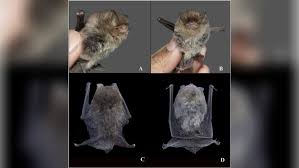
In a breakthrough for India’s wildlife research, scientists have recorded Titania’s woolly bat (Kerivoula titania) in Meghalaya for the first time, expanding the known range of this elusive species by nearly 500 kilometres westward. This discovery also raises India’s bat diversity count to 137 species.
The finding comes from the Khasi Hills, where a team of researchers—including Uttam Saikia, Manuel Ruedi, Rohit Chakravarty, Jennifer Lyngdoh, Rajib Goswami, and Gábor Csorba—captured a lone male bat during a field survey in December 2024. The specimen was found in a community-managed forest near Thankharang village in the East Khasi Hills district at around 870 metres above sea level.
The bat was caught at 7:30 pm using a two-bank harp trap set along a narrow forest trail beneath dense canopy cover. To enhance capture success, the team employed a specialized bat lure that replayed pre-recorded ultrasonic echolocation calls. The specimen was handled following internationally accepted mammalogical and ethical guidelines.
Extensive analyses—including external morphology, craniodental measurements, wing structure evaluation, echolocation call assessment, and mitochondrial DNA sequencing—confirmed the bat’s identity as Kerivoula titania. The study also provided the first description of the species’ baculum, or penile bone, offering a valuable reference for future taxonomic and evolutionary studies.
For comparative purposes, co-author Gábor Csorba examined the holotype and 18 other specimens from Vietnam and Cambodia, reinforcing the identification. Previously, K. titania was thought to inhabit only parts of Southeast Asia, including Myanmar, Thailand, Laos, Cambodia, Vietnam, and China’s Yunnan province, with earlier reports from Taiwan and Hainan later identified as the closely related Kerivoula furva.
Phylogenetic analysis of two mitochondrial genes placed K. titania in a distinct evolutionary clade, separate from the hardwickii species complex, with the Indian specimen confirming this classification.
The researchers emphasize that the discovery underscores the importance of continued biodiversity surveys in Northeast India, especially in community-managed forests, which remain hotspots for species previously unknown from the country.