Saikul, Kangpokpi:
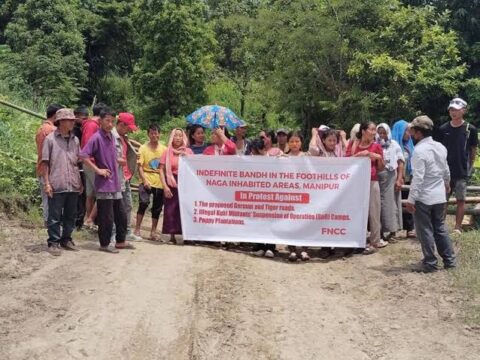
The Outer Manipur Kuki Internally Displaced Persons Welfare Association has strongly opposed the imposition of the “free movement” policy in Manipur, warning that enforcing such a measure without justice and security safeguards could prove to be “a time bomb waiting to detonate.”
In a press statement issued today by its Media and Publicity Secretary, the Association expressed deep concern over what it termed a unilateral and inequitable policy, arguing that it fails to reflect the ground realities faced by thousands of Kuki people who remain internally displaced. The statement noted that rather than ensuring freedom, the policy has heightened fear, insecurity, and vulnerability among affected communities.
According to the statement, while movement has been facilitated along key highways, Kuki-dominated areas continue to face restrictions, threats, and insecurity, particularly along strategic inter-district routes such as Kangpokpi–Tengnoupal and Churachandpur corridors. The Association described this as “discriminatory mobility,” undermining constitutional principles of equality and fairness.
Highlighting the scale of the humanitarian crisis, the Association reported that over 230 civilians have been killed, at least 491 individuals injured, and more than 2,730 homes destroyed, leading to losses exceeding ₹43,000 crore. It further stated that over 230 villages in hill areas have been reduced to ashes, with many still lacking adequate security for safe return and rehabilitation.
The statement also raised concerns about alleged violations of constitutional safeguards in hill areas, including the extension of land revenue jurisdiction and police station jurisdictions into notified tribal regions, in contravention of existing laws and Article 371C. It further cited irregularities in property registration processes, claiming that such actions amount to structural encroachment into protected tribal territories.
The Association asserted that there is no credible assurance that the “free movement” policy would prevent further violence. In the absence of justice, accountability, and neutral security arrangements, it warned that the policy could aggravate tensions and trigger renewed instability.
Calling for systemic reforms, the body emphasized that mere political changes without institutional accountability would not restore public confidence. It reiterated the demand for a separate administrative arrangement for the Kuki people, describing it as a constitutional necessity to ensure self-governance, protection of ancestral lands, and long-term peace.
The Association also expressed disappointment with ten Kuki MLAs, accusing them of failing to adequately represent the concerns of their constituents during the crisis. It called upon them to resign on moral grounds if they cannot effectively uphold their responsibilities.
Among its key demands are immediate intervention by the Government of India to halt the current form of the “free movement” policy, implementation of a comprehensive loan waiver for all Kuki IDPs, and provision of fair compensation under the relevant land acquisition and rehabilitation laws. It also sought safe and dignified resettlement, deployment of neutral central security forces, strict enforcement of constitutional protections, and dismantling of allegedly unlawful police jurisdictions in hill areas.
Additionally, the Association called for a structured ex-gratia and victim compensation framework, employment support for affected families, long-term rehabilitation for the disabled, and a dedicated scheme for village volunteers. It also urged authorities to identify and prosecute those responsible for violence through independent and time-bound investigations.
The Association further stressed that peace cannot be achieved without justice and warned that any attempt to impose stability without addressing underlying grievances would only deepen the crisis.