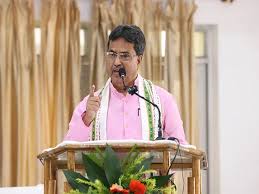
Tripura Chief Minister Manik Saha on January 9 hailed the VBG RAMG Act as a transformative policy aimed at boosting rural livelihoods. He also criticized the opposition for continuing protests despite the legislation having already been passed by Parliament.
At a press conference held at the state BJP office, Saha pointed out that the Bill had undergone rigorous debate in both the Lok Sabha and Rajya Sabha, yet protests outside Parliament were now creating unnecessary confusion. “It’s strange that, even after the Bill’s passage, the opposition continues to protest outside,” he remarked.
Saha explained that the new law was developed after a thorough assessment of the limitations of previous rural employment programs. He cited the evolution of employment guarantee schemes, noting that while MNREGA provided a national legal framework, it also had significant loopholes.
He emphasized that the VBG RAMG Act aims to replace MNREGA with a more robust system that offers enhanced work guarantees, dedicated funding, and a focus on building lasting assets. “Earlier, there was work, but it lacked sustainability,” he said, stressing the need for reforms to ensure “ease of living, ease of doing, and ease of business.”
According to Saha, the Act raises the guaranteed employment from 100 to 125 days and introduces stricter accountability measures. He highlighted that the Centre has allocated over Rs 95,000 crore for the program, with a focus on timely wage payments and greater decentralization through Gram Sabhas.
Calling the VBG RAMG Act a “historic step,” Saha expressed his gratitude to Prime Minister Narendra Modi for prioritizing rural India’s development. He underlined the importance of expanding development efforts beyond urban areas to ensure socio-economic growth in villages.
The Chief Minister also pointed out that the law places significant emphasis on water conservation, asset creation, livelihood generation, rural infrastructure, and climate change mitigation, marking a notable shift in India’s approach to rural employment and development.