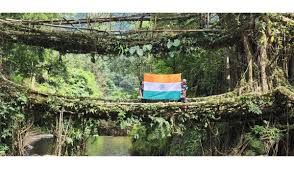
Meghalaya is a step closer to global recognition of its extraordinary living heritage, as India has formally submitted the nomination of the State’s living root bridges to UNESCO. The nomination, titled “Jingkieng Jri / Lyu Chrai Cultural Landscape”, is under consideration for the 2026–27 World Heritage evaluation cycle.
The dossier was handed over by India’s Ambassador and Permanent Representative to UNESCO, Vishal V. Sharma, to Lazare Assomo Eloundou, Director of UNESCO’s World Heritage Centre.
Spanning the Khasi and Jaintia Hills, the nominated cultural landscape highlights a centuries-old living tradition nurtured by the indigenous Khasi and Jaintia communities. It reflects a profound harmony between people, nature, and spiritual beliefs, expressed through traditional land management, community governance, and sustainable ecological practices.
Central to the nomination are the living root bridges, which symbolize the indigenous philosophy of coexistence with nature and respect for Mei Ramew (Mother Earth).
Ambassador Sharma acknowledged the leadership of the Prime Minister, the Union Minister for Culture, the Chief Minister of Meghalaya, as well as the contributions of the Archaeological Survey of India, the Ministry of External Affairs, and local communities who continue to safeguard this heritage.
The submission underscores India’s commitment to preserving living cultural landscapes and promoting international heritage conservation through UNESCO.