Dr. Mehnaz J.P. |
The creation of the Frontier Nagaland Territorial Authority marks a defining institutional milestone in the evolving political history of Nagaland. It represents reform shaped through dialogue, anchored in constitutionalism, and directed toward socio economic justice. Within this steady progression lies the promise of a golden era in Nagaland politics. It is a moment that reflects decisive leadership, cooperative federalism, and a renewed commitment to inclusive growth.
The significance of the Frontier Nagaland Territorial Authority becomes clearer when viewed within the constitutional journey of the State. Nagaland entered the Union of India with distinctive safeguards under Article 371A, protecting customary law, social practices, and ownership of land and resources while functioning within the framework of fundamental rights. In the early years of statehood, special transitional arrangements were extended to Tuensang in recognition of infrastructural limitations and administrative realities. These measures reflected the flexibility of Indian federalism and its responsiveness to regional conditions. Over time, disparities in development across districts shaped public discourse and policy reflection. Gradually, the demand for reform matured into structured democratic articulation. The emergence of the FNTA forms part of this continuing constitutional evolution guided by national unity and regional empowerment.
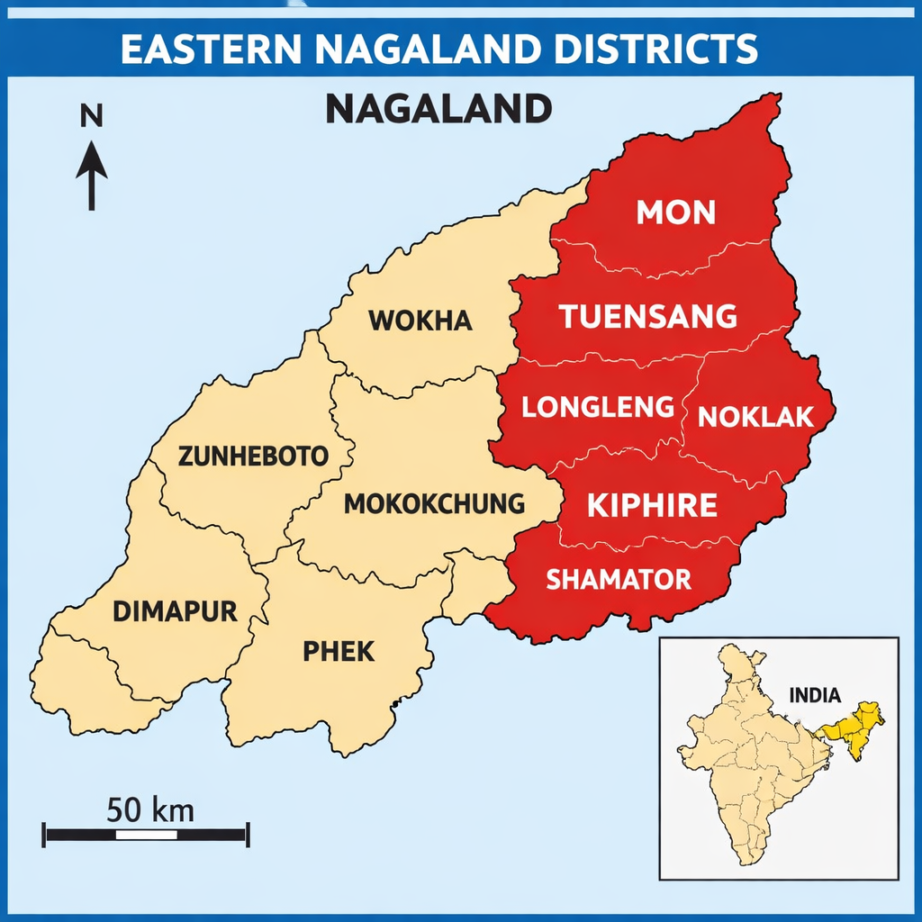
Within this constitutional setting, the eastern districts of Tuensang, Mon, Kiphire, Longleng, Noklak, and Shamator expressed a sustained aspiration for political equity and balanced development. Geography influenced opportunity, and remoteness affected infrastructure, markets, and public services. Civil society organizations and tribal institutions engaged in dialogue, ensuring that regional concerns were articulated within constitutional boundaries. Representation developed into negotiation, and negotiation led to policy design. This progression transformed aspiration into institutional possibility. The demand was framed as corrective justice within the State, strengthening unity while advancing reform.
The Frontier Nagaland Territorial Authority emerged from this atmosphere of constitutional engagement. The tripartite understanding between the Government of India, the Government of Nagaland, and the Eastern Nagaland Peoples’ Organisation provided the formal structure for reform. Identified subjects were devolved to enable localized planning and implementation, bringing governance closer to the people. The arrangement operates within the existing constitutional order and leaves Article 371A safeguards intact, reaffirming autonomy within unity. At the signing of the agreement, Union Home Minister Shri Amit Shah ji described the occasion as “a very significant day for a dispute free North East,” underlining the connection between development and peace. The statement reflected national resolve to ensure inclusive growth reaches every region.
Institutional recognition gives practical meaning to governance at the doorstep. When authority functions closer to the people, participation increases and accountability becomes immediate. Clear rules of business, transparent financial procedures, and defined reporting systems strengthen administrative discipline. Predictability builds confidence, and confidence sustains reform. Constitutional principles are translated into daily governance, making democracy visible in practice. Trust strengthens the relationship between citizen and State.
Members of the Legislative Assembly from eastern Nagaland carry a particular responsibility in this framework. As elected representatives in the Nagaland Legislative Assembly, they protect the interests of the Frontier Nagaland Territorial Authority within the legislative forum. Through informed debate and deliberate legislative action, respecting the will of the residents of the region—the final stakeholders—they ensure that necessary Bills, rules, and amendments strengthen the Authority’s foundation. Their work safeguards devolved subjects, clarifies procedures, and improves administrative coherence. In doing so, they reinforce governance of the people, by the people, for the people within the constitutional structure of the State. Legislative commitment secures institutional stability and accountability.
Financial credibility forms the next foundation of confidence. Transparent allocation of resources, timely release of funds, independent audit compliance, and digital monitoring systems convert devolution into visible welfare. When fiscal flows are structured and traceable, justice in distribution becomes measurable. Roads that withstand monsoon conditions, health centres that function reliably, and schools that remain staffed provide tangible evidence of reform. Socio economic justice moves from aspiration to lived reality. Fiscal discipline strengthens governance and sustains public faith.
Institutional authority must be matched by institutional capacity. The eastern districts present terrain related challenges that require technical competence and consistent oversight. Professional planning, systematic training, and effective project management ensure that policy decisions translate into results. Modern administrative tools enhance efficiency and transparency. As implementation improves, public service delivery reflects responsibility and humanity. Competence reinforces credibility and consolidates reform.
Internal equity remains essential to cohesion. The region comprises diverse communities with varying developmental baselines. Balanced resource distribution guided by objective criteria promotes fairness and stability. Consultation with tribal councils, women’s organizations, youth bodies, and civil society institutions strengthens shared ownership of reform. Through inclusion, empowerment of marginalized sections in the State of Nagaland advances alongside dignity and self respect. Fairness within the region deepens unity across the State and strengthens democratic culture.
As governance strengthens, economic transformation gains momentum. The region’s potential in horticulture, agro forestry, forest based enterprises, handloom production, regulated cross border trade, and calibrated industrialization provides a foundation for sustainable growth. Skill development aligned with regional strengths expands opportunity and promotes self reliance. Access to credit and cooperative enterprise encourages entrepreneurship and local initiative. As livelihoods grow, political equity translates into material progress. Welfare acquires a human face grounded in productivity and participation.
Environmental responsibility forms an integral part of this development approach. Watershed management, slope stabilization, scientific land use planning, and climate resilient agriculture protect ecology and livelihoods. Sustainable planning strengthens inter generational fraternity and aligns development with responsibility. Reform grounded in constitutionalism extends beyond administrative structure to responsible care of natural resources. Growth secured in this manner safeguards the future.
At the level of political culture, the FNTA reflects democratic maturity expressed through dialogue and lawful procedure. Dialogue preceded decision, and negotiation shaped agreement within constitutional parameters.
Implementation followed institutional processes, reinforcing legitimacy. Prime Minister Shri Narendra Modi ji described the agreement as “historic” and reflective of a commitment to inclusive growth in the North East, placing the FNTA within a broader national vision of participatory development. Democratic engagement has strengthened cooperative federalism and national integration.
The recognition of a golden era in Nagaland politics depends upon measurable achievement. Durable connectivity, improved healthcare, consistent educational delivery, transparent financial management, expanded digital access, reduced outmigration, and visible upliftment of marginalized communities provide objective benchmarks. Sustained progress across these domains affirms justice and welfare in practice. Performance will determine the legacy of reform and shape historical assessment.
In its culminating vision, the Frontier Nagaland Territorial Authority stands as a decisive constitutional response to regional aspiration. It advances political equity while preserving unity and promotes empowerment while reinforcing constitutionalism. It strengthens democracy while sustaining fraternity across communities. FNTA empowers the hands that remained helpless for generations and places in them the instruments of planning, decision making, and collective progress. It opens before them the possibility to write their own destiny with confidence and to shape development with dignity and self respect. Its study merits inclusion as a new chapter in the Nagaland University syllabus of Undergraduate and Postgraduate courses in Political Science, inviting future scholars to examine it as a living example of negotiated federal reform and democratic consolidation. FNTA marks a new chapter in the Constitutional history of India, demonstrating that the Constitution remains a living instrument capable of responding to regional aspirations through dialogue and democratic design. It affirms that Indian federalism possesses both flexibility and strength, accommodating diversity while reinforcing unity through justice and participation.
From the hills of Eastern Nagaland rises a renewed covenant between people and Constitution, forged in patience, faith, and democratic resolve. In that covenant shines the certainty that when a people claim their rightful voice through lawful means, they shape history and illuminate the path for generations to come. It proclaims that democracy, when trusted and strengthened, becomes the most powerful instrument of peaceful transformation. It declares that a determined people, guided by constitutional faith, can convert long years of waiting into an era of awakening and collective progress. In its success will rest the proof that constitutional faith, collective sacrifice, and disciplined governance can transform aspiration into achievement and open the path toward renewal, healing, and redemption. If sustained with integrity and courage, FNTA will redefine the architecture of governance in Nagaland and inscribe this era in history as a golden chapter forged through unity, justice, and the will of the people. The nation never forgets its heroes, and the sacrifices and contributions of those who shaped this movement form an inseparable part of this constitutional journey, secured in the collective memory of the State and the country. In that shared memory lives the spirit of a united Nagaland contributing with pride to the strength, dignity, and destiny of the Indian nation.
(Dr. Mehnaz is with the Frontier Northeast Policy and Governance Foundation)