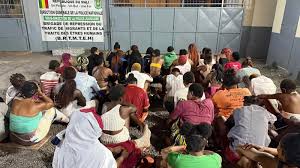
A coordinated global crackdown on human traffickers and migrant smugglers has led to the arrest of more than 3,700 suspects and the protection of over 4,400 potential victims, Interpol announced Monday.
The operation, known as Operation Liberterra III, was carried out between Nov. 10 and Nov. 21 by more than 14,000 officers across 119 countries. Interpol said the effort resulted in 3,744 arrests, the identification of 12,992 people involved in illegal migration schemes, and the launch of at least 720 new investigations.
“Criminal networks are evolving, exploiting new routes, digital platforms and vulnerable populations,” Interpol Secretary General Valdecy Urquiza said. “Identifying these patterns allows law enforcement to anticipate threats, disrupt networks earlier and better protect victims.”
Interpol noted a shift in trafficking patterns, highlighting cases involving South American and Asian victims trafficked into Africa—contrasting with earlier trends in which African victims were primarily trafficked abroad.
Dangerous migration routes remain a major concern. Authorities intercepted migrants along coastal routes in Senegal, Guinea-Bissau, Morocco and Algeria, as well as land-based smuggling networks in Peru, Brazil and other countries.
In West and Central Africa, law enforcement agencies in Benin, Burkina Faso, Côte d’Ivoire, Ghana, Senegal and Sierra Leone rescued more than 200 victims and dismantled multiple recruitment and exploitation hubs.
Interpol said many victims in Africa are lured by promises of overseas employment. Traffickers often charge high fees and then force victims to recruit friends and family members in exchange for better treatment, creating a pyramid-style exploitation scheme.
The agency also pointed to broader enforcement efforts, including a 2025 cybercrime crackdown in Africa that resulted in 1,209 arrests linked to scams targeting 88,000 victims. In Asia, authorities uncovered 450 exploited workers during a single raid on a compound in Myanmar.