A crucial section of National Highway-17 (formerly NH-37) passing through Bijoynagar in South Kamrup, Assam, has deteriorated into a major civic hazard, with broken roads, clogged drains, and foul odors disrupting daily life in one of the region’s busiest commercial centers.
Serving as the only national highway in South Kamrup, NH-17 is a vital artery connecting Assam to neighbouring states via Srirampur. The Bijoynagar stretch, home to the state’s second-largest wholesale market, has become increasingly difficult to navigate, posing serious risks to commuters, pedestrians, and traders.
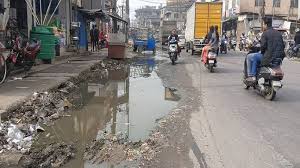
Residents and officials attribute the worsening conditions primarily to a poorly executed drainage project undertaken by the National Highways Authority of India (NHAI) under the Boko subdivision. The multi-crore project, carried out a few years ago in the Upperhali area, involved constructing concrete drains on both sides of the highway. Today, these drains are completely clogged, rendering the system ineffective.
Wastewater frequently overflows onto the road, mixing with stagnant water collected in large potholes. The highway has effectively become an open drain, with foul-smelling water and garbage lining both sides, severely polluting the surroundings.
Local residents claim the drains were built without proper outlets, causing water to stagnate. The problem is compounded by indiscriminate dumping of waste by nearby commercial establishments, further blocking water flow and aggravating the sanitation crisis.
The unhygienic conditions have made daily movement dangerous, especially for pedestrians and students of Upperhali High School and the local Girls’ High School, who must wade through contaminated water to reach their classes. The deteriorating road has also led to accidents; recently, an e-rickshaw overturned after hitting a pothole, seriously injuring the driver and a passenger.
Despite the highway’s strategic importance, residents allege persistent inaction by local representatives and NHAI officials. The lack of timely intervention raises serious concerns about the maintenance, accountability, and monitoring of infrastructure projects in the region.